Does Ozempic make you more fertile?
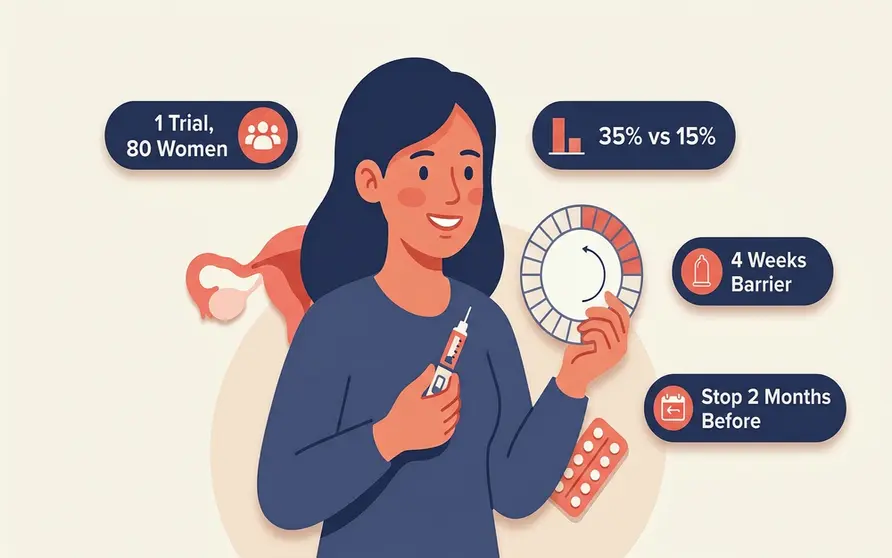
Probably, but not directly. The only tier-1 evidence is a single 80-woman trial in which semaglutide plus metformin produced a 35% pregnancy rate against 15% on metformin alone. The likely mechanism is weight loss restoring ovulation. The birth-control warning that matters applies to tirzepatide, not semaglutide.
"Ozempic babies" has been circulating for more than a year: women who were told they could not conceive, conceiving. The story is plausible, widely repeated, and almost never accompanied by a number.
As of June 2026 there is finally a systematic review to point at. It is worth reading carefully, because the honest version of this answer is smaller and more specific than the headline suggests, and because the practical risk for most readers is not fertility at all. It is contraception.
What does the evidence actually show?
The relevant paper is a systematic review and meta-analysis by Alnaimi and colleagues, published in Clinical Obesity in 2026, which set out to summarise what weight-lowering drugs do to ovulation, conception, pregnancy and live birth rates in women with overweight or obesity.1
The authors screened 2,731 records and found seven eligible clinical trials covering 575 women aged 25.9 to 29.7 years. Six of those seven trials evaluated orlistat, an older weight-loss drug. One trial evaluated a GLP-1 receptor agonist.1
That single trial is Chen and colleagues, conducted in China and published in 2025. It enrolled 80 women with overweight or obesity and polycystic ovary syndrome, followed them for roughly 9.3 months, and compared semaglutide added to metformin against metformin alone.1
Natural pregnancy rates were 35% in the semaglutide plus metformin group and 15% in the metformin alone group, a risk ratio of 2.33 with a 95% confidence interval of 1.05 to 5.19.1 The lower bound of that interval sits at 1.05, barely clear of no effect at all.
How big is the evidence base?
Small, and weaker than its size alone suggests. The review's own risk-of-bias assessment rated five of the seven included studies as high risk of bias, with the remaining two raising some concerns.1
The main sources of that bias were the method of randomisation, allocation concealment and outcome assessment.1 Those are not cosmetic problems. They are the specific design features that stop a trial from over-reporting a benefit.
There is a second gap that matters more to anyone actually trying to conceive. Of the seven trials, none reported live birth rates.1 Pregnancy rate and live birth rate are different outcomes, and the one people care about was not measured.
The authors' own summary of what their work adds is deliberately narrow: limited evidence suggests that semaglutide may enhance natural pregnancy rates, warranting larger studies.1 That sentence is the honest ceiling on this topic today.
What did the tirzepatide trial find?
A second 2026 trial points the same direction with a different drug. Yang and colleagues, publishing in Diabetes, Obesity and Metabolism, randomised 60 overweight or obese Chinese women with polycystic ovary syndrome to metformin alone or metformin plus low-dose tirzepatide, 5 mg once weekly, for 16 weeks.2
The weight difference was large. The combination group lost 10.4 kg against 1.7 kg on metformin alone, with a BMI fall of 4.12 against 0.68 kg/m2 and a reduction in visceral fat of 34.13 against 4.67 cm2, all at p less than 0.001.2
Menstrual cycle recovery and total pregnancy rate were both higher in the combination group, at p = 0.013 and p = 0.014 respectively.2 This is the first published trial to put a number on the outcome PCOS patients describe in plain language: do my periods come back.
One design detail deserves attention, because it is the trialists themselves being cautious. After week 16 participants were switched back to metformin alone, barrier contraception was required for 8 weeks, and pregnancy outcomes were only assessed between weeks 25 and 48.2 Nobody was meant to conceive while taking the drug.
Even the trial that found more pregnancies stopped the drug first and required barrier contraception for eight weeks before letting anyone try. Design of the tirzepatide PCOS trial, Yang et al., Diabetes Obesity and Metabolism, 2026
Why would weight loss restore ovulation?
Because in this population the fertility problem and the weight problem are the same problem. Both trials were run in women with polycystic ovary syndrome, a condition in which insulin resistance and hormonal imbalance disrupt ovulation, and both used a GLP-1 drug on top of metformin rather than instead of it.12
The tirzepatide trial reported improvements in reproductive endocrine and metabolic parameters alongside the weight loss, not separately from it.2 That pattern is consistent with weight loss restoring ovulation, which is the same mechanism by which diet, surgery and older weight-loss drugs improve fertility.
The practical consequence is the one people miss. If the effect runs through weight loss, then anyone losing significant weight on a GLP-1 drug may see ovulation return, whether or not they have PCOS and whether or not they are trying to conceive.
Do GLP-1 drugs affect birth control?
One class does and one does not, and almost every article about "Ozempic babies" gets this backwards by treating the drugs as interchangeable.
The tirzepatide labels carry an explicit contraception instruction. The Mounjaro prescribing information states that use of the drug may reduce the efficacy of oral hormonal contraceptives due to delayed gastric emptying, that this delay is largest after the first dose and diminishes over time, and that patients using oral hormonal contraceptives should switch to a non-oral method or add a barrier method for 4 weeks after initiation and for 4 weeks after each dose escalation.6 The Zepbound label carries the same instruction.7
Both labels add a reassurance worth knowing: hormonal contraceptives that are not administered orally should not be affected.67 An implant, injection, patch, ring or hormonal coil bypasses the stomach entirely.
Semaglutide is different. The Ozempic prescribing information reports that an oral contraceptive containing ethinylestradiol and levonorgestrel was among the medicines formally tested for interaction with semaglutide at steady state, and states that no dose adjustment is required for the medicines evaluated.4 Neither the Ozempic nor the Wegovy label instructs patients to change contraceptive method.45
The mechanism behind the tirzepatide warning is the same delayed gastric emptying that causes the nausea most people notice in the first weeks. If you want the practical side of that, our guide to managing GLP-1 nausea covers what to change first.
How do the four US labels compare?
The table below sets the current US prescribing information side by side, because the differences are specific and easy to check.
| Drug | Oral contraceptive instruction | Before a planned pregnancy | Label revised |
|---|---|---|---|
| Ozempic (semaglutide) | None; no dose adjustment required | Stop at least 2 months before | May 2026 |
| Wegovy (semaglutide) | None stated | Stop at least 2 months before | June 2026 |
| Mounjaro (tirzepatide) | Non-oral or barrier, 4 weeks after start and each dose rise | No timing rule stated | April 2026 |
| Zepbound (tirzepatide) | Non-oral or barrier, 4 weeks after start and each dose rise | Stop when pregnancy is recognised | April 2026 |
Sources: US prescribing information for Ozempic4, Wegovy5, Mounjaro6 and Zepbound7, as published on DailyMed. All four labels say to stop the drug once a pregnancy is recognised. Product information outside the United States may differ.
When should you stop before pregnancy?
For semaglutide the label gives a number. Both the Ozempic and the Wegovy prescribing information instruct patients to discontinue the drug at least 2 months before a planned pregnancy, because of the long half-life of semaglutide.45
The Wegovy patient information puts it in plain words: you should stop using Wegovy 2 months before you plan to become pregnant.5
The tirzepatide labels do not state an equivalent waiting period. Mounjaro's pregnancy section says the drug may cause fetal harm based on animal studies, and Zepbound instructs prescribers to discontinue when a pregnancy is recognised.67
None of this is a decision to make alone. Stopping a drug that is controlling blood glucose or weight has its own consequences, and the timing question belongs with the person who prescribed it. The difference between semaglutide and tirzepatide is one of several reasons the answer is not the same for everyone.
What if you conceive while taking it?
This is the more common scenario, and the evidence here is genuinely reassuring rather than merely absent. A 2026 meta-analysis by Uysal and colleagues, published in Scientific Reports, pooled seven cohort studies covering over 40,000 exposed pregnancies and found no statistically significant increase in any congenital malformation, at an odds ratio of 1.11 (95% CI 0.82 to 1.51).3
Through 2026 that evidence base grew much larger, and it stayed reassuring about accidental exposure while still not proving safety. We cover the full picture, including a meta-analysis of 2.1 million pregnancies and the diabetes-linked signal that complicates it, in a dedicated guide on whether Ozempic is safe if you get pregnant on it.
Reassuring about an accident is not the same as approval for planned use. None of these drugs is approved or recommended during pregnancy, and every label above says to stop once a pregnancy is recognised.4567
In one sentence: GLP-1 drugs probably do improve the odds of conceiving, mostly by causing the weight loss that restores ovulation, but the entire randomised evidence for semaglutide is one 80-woman trial, and the thing most readers actually need to act on is that tirzepatide can weaken oral contraception while semaglutide does not.
Frequently asked
Does Ozempic make you more fertile?+
Do I need to worry about birth control on Ozempic?+
How long before pregnancy should I stop?+
References
- Alnaimi SJ, Alsugeir DM, Wei L, Harvey K, Brauer R. Weight-lowering drugs and natural female fertility: a systematic review and meta-analysis. Clin Obes. 2026;16(4):e70092. Clinical Obesity. doi:10.1111/cob.70092. PMID: 42307450. PMCID: PMC13274556. Open access. No funding statement was returned in the bibliographic record.
- Yang Z, Xu Y, Du H, Liu W, Chen H, Liu D, Zhang L, Wang C. Short-term combined treatment with tirzepatide and metformin for overweight or obese Chinese women with polycystic ovary syndrome: a prospective, open-label, randomised controlled trial. Diabetes Obes Metab. 2026;28(8):7380-7392. PubMed. doi:10.1111/dom.70966. PMID: 42236268. Trial registration ChiCTR2400090908.
- Uysal N, Horoz E, Gungor M, Timarci I, Sozmen MK, Karadas B, Kaplan YC. Pregnancy outcomes following maternal GLP-1 receptor agonist exposure: a systematic review and meta-analysis. Sci Rep. 2026. PubMed. doi:10.1038/s41598-026-61582-8. PMID: 42420519. Published online 8 July 2026.
- Novo Nordisk. OZEMPIC (semaglutide) injection, for subcutaneous use: US prescribing information, revised May 2026. DailyMed, US National Library of Medicine. Sections 8.3 and 12.3 were checked for contraception and drug-interaction wording.
- Novo Nordisk. WEGOVY (semaglutide) injection, for subcutaneous use: US prescribing information, revised June 2026. DailyMed, US National Library of Medicine. Sections 8.1 and 8.3 and the patient information leaflet were checked.
- Eli Lilly and Company. MOUNJARO (tirzepatide) injection, for subcutaneous use: US prescribing information, revised April 2026. DailyMed, US National Library of Medicine. Sections 7.2 and 8.3 carry the oral contraceptive instruction.
- Eli Lilly and Company. ZEPBOUND (tirzepatide) injection, for subcutaneous use: US prescribing information, revised April 2026. DailyMed, US National Library of Medicine. Sections 7.2, 8.1 and 8.3 were checked.
Evidence current as of July 30, 2026. This article is educational only and is not medical advice. Semaglutide and tirzepatide are prescription-only and should be used under medical supervision. None of these drugs is approved or recommended for use during pregnancy. Both trials described above were conducted in women with polycystic ovary syndrome and are small, so their results may not apply to other groups, and individual results vary. Contraception, conception timing and stopping any prescribed medicine are decisions to make with your own clinician.
Translating new metabolic and obesity research into plain English for people living on GLP-1 therapy. Every claim is traced to its source.