Does Ozempic stop working when the hunger comes back?
No. In a 60-week randomized trial at the University of Pennsylvania, adults on semaglutide 2.4 mg still ate 24% to 30% fewer calories than placebo at week 60, even though their reported hunger no longer differed from placebo after week 20. Felt appetite faded. Measured eating did not.
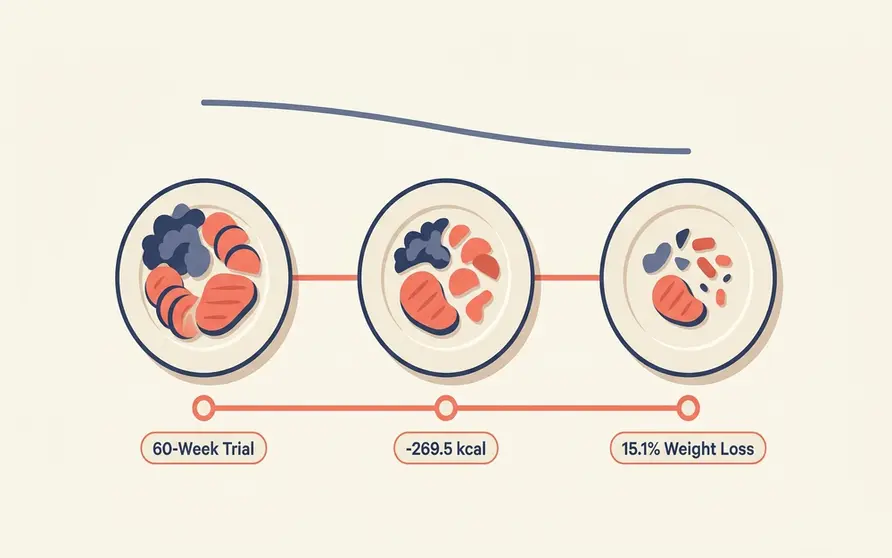
The most common reason people on GLP-1 medication believe their drug has failed is simple: the hunger comes back. The quiet weeks turn noisy again, food thoughts return, and the scale slows down. A 60-week randomized trial published in the American Journal of Clinical Nutrition in June 2026 tested that exact suspicion, and found that returning appetite and returning calorie intake are two different things.1
One clarification first, because the question is almost always asked about Ozempic. Ozempic and Wegovy are both semaglutide, sold under different brand names for different indications. This trial used the 2.4 mg weekly dose, the dose approved for weight management and sold as Wegovy.
What did the Penn trial measure?
The trial randomly assigned 120 adults with overweight or obesity, in a 3:2 ratio, to semaglutide 2.4 mg or placebo for 60 weeks, double-blind.1 At weeks 0, 20, 40 and 60, participants came into a laboratory, rated their appetite while fasting and for four hours after a standardized breakfast, then ate as much as they wanted at a lunch whose calories were measured.1
That design is why the study matters. Earlier semaglutide appetite research ran 20 weeks or less, so it could show the drug suppresses appetite early but could not show whether the effect lasts.1 The Penn trial is the first to measure the same people's actual food intake at 20, 40 and 60 weeks.
Does the hunger really come back?
Partly, yes, and the trial confirms it rather than dismissing it. At week 20, the semaglutide group reported significantly less hunger, less preoccupation with food, and greater appetite suppression after breakfast than the placebo group.1 At weeks 40 and 60, none of those appetite differences reached statistical significance.1
In other words, the feeling that the drug is doing less is not imagined. What people report about their own hunger at one year genuinely looks closer to placebo than it did at five months.
How much less did people actually eat?
Measured calorie intake did not fade. Semaglutide produced significantly greater reductions in freely chosen energy intake than placebo at every single timepoint, and the week-60 gap was larger than the week-40 gap.1
| Timepoint | Calories eaten vs placebo | Reported appetite vs placebo |
|---|---|---|
| Week 20 | -291.9 kcal | Less hunger, less food preoccupation |
| Week 40 | -240.2 kcal | No significant difference |
| Week 60 | -269.5 kcal | No significant difference |
Source: Tronieri et al., American Journal of Clinical Nutrition, 2026.1 Values are between-group differences in energy eaten at an ad libitum laboratory lunch, not total 24-hour dietary intake. Figures are group averages; individual results vary.
Penn Medicine summarizes the same data as roughly 24% to 30% fewer calories than placebo at those laboratory meals, sustained through week 60.2 Average weight loss at week 60 was 15.1% of starting body weight on semaglutide, against 3.4% on placebo.2
Why does eating stay low if hunger returns?
The trial measured what happened, not why, and its authors do not claim a mechanism. One clue sits in the data: food responsiveness, measured with the Power of Food Scale, was still improved on semaglutide at weeks 20 and 40.1 The pull that food exerts appears to stay dampened for longer than the sensation of hunger itself.
A second explanation is measurement. Rated hunger is what a person notices and reports; energy intake is what they eat. The two can move apart, which is the trial's central and most useful finding for patients.
"This study highlights an important distinction between people's perceptions of their appetite and how they actually eat." Thomas A. Wadden, PhD, Professor of Psychology in Psychiatry, University of Pennsylvania
Is a weight plateau a sign it failed?
A plateau and a failing drug are not the same thing. In the Penn trial, calorie intake stayed 240 to 292 kcal below placebo at every measured timepoint through week 60 while weight loss averaged 15.1%.12 The drug was still acting the whole time.
Weight loss slows because the body burns less energy as it gets lighter, so intake and expenditure eventually meet again at a lower weight. A flat scale is that meeting point, not a sign the medication has quit.
What did earlier, shorter studies show?
The early-treatment effect is large and well documented. In a 20-week double-blind trial of 72 adults with obesity, semaglutide 2.4 mg cut freely chosen lunch intake by 35% versus placebo (1736 versus 2676 kJ), reduced hunger, increased fullness, and produced 9.9% weight loss against 0.4% on placebo.3
What that 2021 trial could not answer is whether the effect survives past five months. The Penn trial answers it: the calorie effect survives, the hunger effect largely does not.1
What happens if you stop the drug?
Feeling hungrier while still taking semaglutide is a different situation from stopping it. In the STEP 1 trial extension, 327 participants were followed for a year after semaglutide 2.4 mg and lifestyle support were withdrawn.4
They regained 11.6 percentage points of the weight they had lost, leaving a net loss of 5.6% from baseline compared with 17.3% at the end of treatment.4 That is roughly two-thirds of the loss reversed, with cardiometabolic markers moving back toward baseline as well.4
Who funded the study?
The Penn trial was supported in part by a Novo Nordisk research grant awarded to the University of Pennsylvania through the company's Investigator Sponsored Studies Program.2 Novo Nordisk manufactures semaglutide.
That funding does not invalidate the result, and the design guards against the obvious bias: it was randomized, double-blind and placebo-controlled. It is also worth noting that part of the finding is unflattering to the drug, since it documents the subjective appetite benefit fading after week 20. Readers should still know who paid.
What should you do if hunger returns?
On this evidence, returning hunger by itself is not a sign that semaglutide has stopped working, and it is not a reason to change your own dose. Dose adjustments, plateaus and side effects are clinical decisions that belong with the prescriber who knows your history.
What does change with a sustained 240 to 290 kcal daily shortfall is the nutritional quality of what remains on the plate. Eating substantially less for over a year is also how lean muscle mass gets lost alongside fat, and it is the reason protein and micronutrient intake matter more on GLP-1 therapy than off it. If you are weighing semaglutide against tirzepatide, the head-to-head weight-loss comparison is covered separately.
In one sentence: semaglutide 2.4 mg kept people eating 240 to 292 fewer calories than placebo through 60 weeks even after their reported hunger returned to placebo levels, so the hunger coming back is not evidence that the drug stopped working.
Frequently asked
Does Ozempic stop working after a year?+
Why do I feel hungrier on semaglutide than I did at the start?+
Is a weight-loss plateau a sign the drug has failed?+
What happens if you stop taking semaglutide?+
References
- Tronieri JS, Allison KC, DeRouen K, Amaro A, Collins KG, Roy A, Watts S, Ananna T, Wadden TA. Short- and long-term effects of semaglutide 2.4 mg on energy intake, appetite, and food reward: a 60-week, double-blind randomized controlled trial. Am J Clin Nutr. 2026 Jun 20:101403. PubMed. doi:10.1016/j.ajcnut.2026.101403. PMID: 42323166.
- Penn Medicine. Semaglutide sustains lower calorie intake for more than a year. News release. University of Pennsylvania, July 21, 2026.
- Friedrichsen M, Breitschaft A, Tadayon S, Wizert A, Skovgaard D. The effect of semaglutide 2.4 mg once weekly on energy intake, appetite, control of eating, and gastric emptying in adults with obesity. Diabetes Obes Metab. 2021;23(3):754-762. PubMed. doi:10.1111/dom.14280. PMID: 33269530.
- Wilding JPH, Batterham RL, Davies M, et al. Weight regain and cardiometabolic effects after withdrawal of semaglutide: The STEP 1 trial extension. Diabetes Obes Metab. 2022;24(8):1553-1564. PubMed. doi:10.1111/dom.14725. PMID: 35441470.
Evidence current as of July 27, 2026. This article is educational only and is not medical advice. Semaglutide is prescription-only and should be used under medical supervision. Individual results vary. Never change your dose or stop treatment without speaking to your clinician.
Translating new metabolic and obesity research into plain English for people living on GLP-1 therapy. Every claim is traced to its source.