How do I deal with Ozempic nausea without quitting?
Nausea is the most common side effect of GLP-1 therapy, reported by 44% of adults on Wegovy against 16% on placebo. It is usually worst during dose escalation and eases with time. The published clinical guidance is to slow the titration and change how you eat, not to stop the drug.
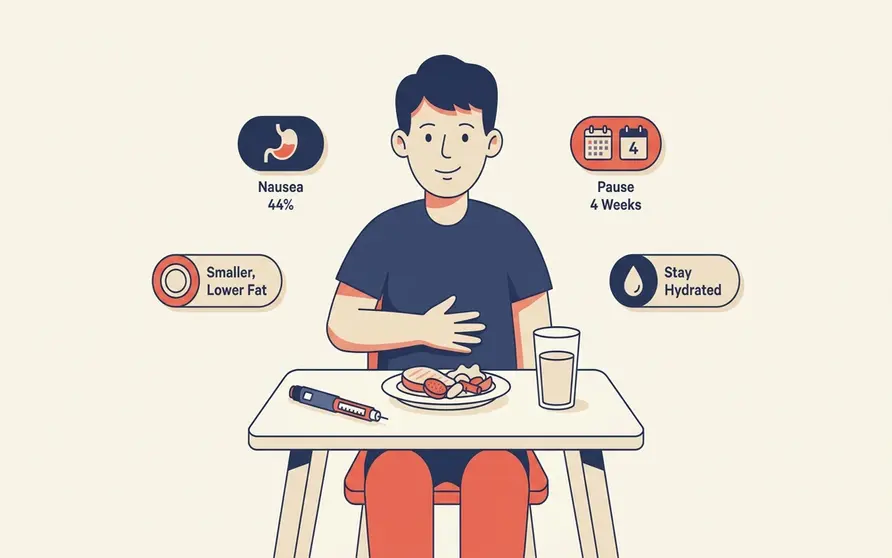
Gastrointestinal side effects are the single most common reason people abandon GLP-1 therapy, and they usually arrive at the worst possible moment: in the first weeks, before any meaningful weight change has happened. A clinical guide published in EClinicalMedicine in May 2026 was written specifically to address that gap, and it includes a published algorithm for managing early gastrointestinal symptoms.1
One clarification first. Ozempic and Wegovy are both semaglutide, sold under different brand names for different indications, and Mounjaro and Zepbound are both tirzepatide. The adverse-reaction figures below come from the weight-management labels, Wegovy and Zepbound.
How common is nausea on GLP-1 drugs?
Nausea is the most frequently reported adverse reaction in both drug classes, and the difference from placebo is large. The Wegovy prescribing information lists nausea in 44% of adults treated with semaglutide 2.4 mg, compared with 16% on placebo.2
Vomiting, diarrhea and constipation follow the same pattern. The table below sets the two labels side by side, using the highest tirzepatide dose for the Zepbound column.
| Symptom | Wegovy 2.4 mg | Placebo | Zepbound 15 mg | Placebo |
|---|---|---|---|---|
| Nausea | 44% | 16% | 28% | 8% |
| Diarrhea | 30% | 16% | 23% | 8% |
| Vomiting | 24% | 6% | 13% | 2% |
| Constipation | 24% | 11% | 11% | 5% |
| Abdominal pain | 20% | 10% | 10% | 5% |
Sources: WEGOVY prescribing information2 and ZEPBOUND prescribing information3. The two labels come from separate trial programs with different populations, so the two placebo columns are not directly comparable with each other. Figures are group rates; individual experience varies.
Do the stomach symptoms go away?
For most people they ease. The EClinicalMedicine guide describes gastrointestinal effects as predictable and dose-dependent, most common during initiation and dose escalation, and generally improving over time.1
The trial evidence says the same thing. In STEP 1, the 68-week trial of semaglutide 2.4 mg in 1,961 adults with overweight or obesity, nausea and diarrhea were the most common adverse events and were described as typically transient and mild-to-moderate in severity, subsiding with time.4 In SURMOUNT-1, the 72-week tirzepatide obesity trial in 2,539 adults, gastrointestinal events were mostly mild to moderate and occurred primarily during dose escalation.5
That timing detail matters more than it sounds. If symptoms cluster around dose increases, then the dose schedule is the lever, and it is a lever the labels explicitly allow clinicians to pull.
Should you pause the dose increase?
This is the first thing the labels tell prescribers to consider. The Wegovy prescribing information states that if patients do not tolerate a dose during dosage escalation, clinicians should consider delaying the escalation for 4 weeks.2 The Zepbound label says to consider a lower maintenance dosage if a patient does not tolerate the one they are on.3
Neither drug is meant to be escalated on a fixed timetable regardless of how the patient feels. Wegovy's standard schedule moves from 0.25 mg to 0.5 mg to 1 mg to 1.7 mg in four-week steps before reaching maintenance.2 Zepbound starts at 2.5 mg weekly and rises in 2.5 mg increments after at least four weeks, to a maximum of 15 mg.3
The EClinicalMedicine guide goes one step further for persistent symptoms: step back one dose level, then reassess hydration and nutrition before resuming the climb.1
The published response to persistent symptoms is to pause or step back a dose level and check hydration and nutrition, not to abandon treatment. The approach described by Moiz and colleagues, EClinicalMedicine, 2026
What does the clinical guide advise?
The EClinicalMedicine guide sets out supportive dietary and behavioral measures as the first response to early symptoms, before any change to the drug itself.1 The measures it names are unglamorous and specific.
- Smaller, more frequent meals, eaten more slowly rather than in large portions.1
- Less fat, since high-fat foods sit longest in a stomach that is already emptying more slowly.1
- No late-night eating.1
- Steady hydration, which the guide treats as a priority rather than an afterthought.1
The guide also notes that when vomiting, diarrhea or dehydration are sustained, clinicians may reassess electrolytes and kidney function.1 That is not a self-management step, but it is worth knowing it exists, because it is a reason to report ongoing symptoms rather than wait them out silently.
Two honest limits on this advice. The guide is a narrative clinical review rather than a randomized trial of these measures, so it represents expert synthesis, not proof that any one tactic works. And it reports no incidence figures of its own, which is why the numbers in this article come from the drug labels and the pivotal trials instead.1
Which symptoms need urgent medical care?
Some abdominal symptoms are not part of the ordinary adjustment period. The guide is direct about the main one: severe pain in the upper abdomen radiating to the back, particularly alongside vomiting, should raise concern for pancreatitis, and warrants stopping the drug and getting immediate medical evaluation.1
Gallbladder disease is the second. The guide advises patients to promptly report persistent upper abdominal pain, nausea or vomiting.1 The Wegovy label records gallstones in 1.6% of treated adults versus 0.7% on placebo.2
Dehydration is the third and the most preventable. The Wegovy label carries postmarketing reports of acute kidney injury, some requiring dialysis, in patients whose gastrointestinal reactions led to dehydration.2 This is the mechanism that turns a manageable side effect into a hospital visit, and it is why hydration keeps appearing in the guidance.
How many people quit over side effects?
Fewer than the volume of complaint suggests. In STEP 1, 4.5% of participants taking semaglutide 2.4 mg discontinued because of gastrointestinal events, against 0.8% on placebo.4 In SURMOUNT-1, adverse events of any kind, not just gastrointestinal ones, caused treatment discontinuation in 4.3%, 7.1% and 6.2% of the 5 mg, 10 mg and 15 mg tirzepatide groups, versus 2.6% on placebo.5
Real-world figures are far worse than trial figures, for reasons that include cost and access as well as tolerability. A companion 2026 review by the same Montreal group reports that up to 65% of real-world users discontinue GLP-1 therapy within a year of starting.6
Why does staying on the drug matter?
Because stopping reverses most of the benefit. The same review reports that roughly two thirds of lost weight is typically regained within a year of discontinuation, often with cardiometabolic improvements reversing alongside it.6
The review attributes that regain to physiological, behavioral and environmental factors acting together once pharmacological appetite suppression is removed, not to a failure of willpower.6 That framing matters for anyone deciding whether a difficult first month is worth pushing through with clinical support.
What can you do this week?
Nothing in this article is a reason to change your own dose. Dose timing, titration pauses and step-downs are prescribing decisions, and the labels direct those decisions to a clinician who knows your history.23
What you can do is arrive at that conversation with specifics: which week the symptoms started, whether they began after a dose increase, how much you are managing to drink, and whether the pain is the ordinary queasy kind or the severe radiating kind described above.
Eating substantially less for months also has a nutritional cost of its own, which is why lean muscle loss on GLP-1 therapy and protein intake are worth tracking alongside side effects. And if your worry is the opposite one, that returning hunger means the drug has stopped working, the 60-week trial evidence on that question is covered separately.
In one sentence: nausea affects 44% of people on semaglutide 2.4 mg and is worst during dose escalation, and the published clinical response is to slow the titration, shrink and de-fat the meals, keep drinking, and escalate to a clinician rather than quit.
Frequently asked
How long does nausea last on Ozempic or Wegovy?+
Can I slow down my dose increase to avoid nausea?+
When is stomach pain on a GLP-1 drug an emergency?+
How many people stop GLP-1 treatment because of side effects?+
References
- Moiz A, Peters TM, Tsoukas MA, Yu OHY, Filion KB, Eisenberg MJ. Balancing the benefits and risks of GLP-1 receptor agonists: a clinical guide for shared decision-making. EClinicalMedicine. 2026;96:103991. PubMed. doi:10.1016/j.eclinm.2026.103991. PMID: 42238011. The authors state the study received no external funding; two authors disclose speaker fees or personal fees from pharmaceutical companies, including Novo Nordisk and Eli Lilly.
- Novo Nordisk. WEGOVY (semaglutide) injection, for subcutaneous use: US prescribing information. DailyMed, US National Library of Medicine.
- Eli Lilly and Company. ZEPBOUND (tirzepatide) injection, for subcutaneous use: US prescribing information. DailyMed, US National Library of Medicine.
- Wilding JPH, Batterham RL, Calanna S, et al; STEP 1 Study Group. Once-weekly semaglutide in adults with overweight or obesity. N Engl J Med. 2021;384(11):989-1002. PubMed. doi:10.1056/NEJMoa2032183. PMID: 33567185.
- Jastreboff AM, Aronne LJ, Ahmad NN, et al; SURMOUNT-1 Investigators. Tirzepatide once weekly for the treatment of obesity. N Engl J Med. 2022;387(3):205-216. PubMed. doi:10.1056/NEJMoa2206038. PMID: 35658024.
- Moiz A, Filion KB, Knauper B, Tsoukas MA, Brazeau AS, Zolotarova T, Lelievre A, Eisenberg MJ. Weight maintenance after discontinuation of GLP-1 therapies. EClinicalMedicine. 2026;96:103992. PubMed. doi:10.1016/j.eclinm.2026.103992. PMID: 42256676.
Evidence current as of July 28, 2026. This article is educational only and is not medical advice. Semaglutide and tirzepatide are prescription-only and should be used under medical supervision. Individual results vary. Never change your dose, delay a titration step or stop treatment without speaking to your clinician, and seek urgent care for severe abdominal pain, persistent vomiting or signs of dehydration.
Translating new metabolic and obesity research into plain English for people living on GLP-1 therapy. Every claim is traced to its source.