Retatrutide and TRIUMPH-1: what we know so far
Retatrutide is an experimental once-weekly obesity drug from Eli Lilly that activates three hormone receptors: GLP-1, GIP, and glucagon. Its pivotal Phase 3 trial, TRIUMPH-1, enrolled 2,335 adults and finished in April 2026, but no results are published yet. What we know comes from its Phase 2 trial.
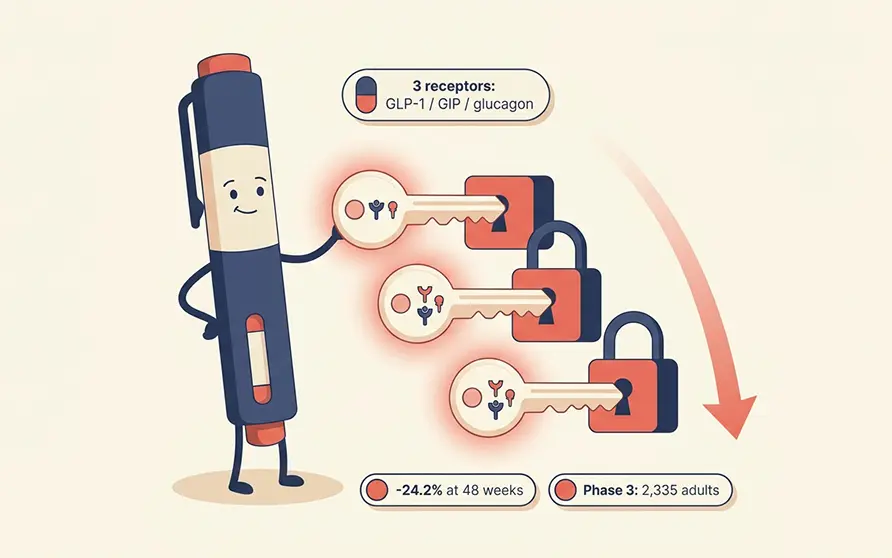
Retatrutide is an experimental obesity drug from Eli Lilly, and in April 2026 its pivotal Phase 3 trial, TRIUMPH-1, finished after enrolling 2,335 adults.1 The drug is unusual because it activates three hormone receptors at once, and in Phase 2 testing its highest dose produced an average 24.2% body-weight reduction at 48 weeks.2 This article explains what retatrutide is, what TRIUMPH-1 measured, and why its headline results are not public yet.
What is retatrutide?
Retatrutide is an experimental once-weekly injection that activates three hormone receptors at the same time: GLP-1, GIP, and glucagon.2 That makes it a triple-hormone-receptor agonist, one step beyond tirzepatide (Mounjaro, Zepbound), which activates only GLP-1 and GIP, and two steps beyond semaglutide (Ozempic, Wegovy), which activates GLP-1 alone. The GLP-1 and GIP components curb appetite and slow digestion, while the added glucagon-receptor activation is thought to increase the body's energy expenditure.2
Retatrutide, also known by its development code LY3437943, is not approved and cannot be prescribed. It is still moving through Eli Lilly's Phase 3 testing program, called TRIUMPH, of which TRIUMPH-1 is the core obesity trial.1
What is the TRIUMPH-1 trial testing?
TRIUMPH-1, registered as NCT05929066, is the Phase 3 trial designed to confirm retatrutide's weight-loss effect in people with obesity.1 Eli Lilly built it as a randomized, double-blind, placebo-controlled trial in 2,335 adults who have obesity or are overweight but do not have type 2 diabetes.1 Participants were assigned to one of three retatrutide doses or a matching placebo, self-injected once weekly.1
The main question is how much body weight participants lose, measured as the percentage change from baseline at week 80, with a further reading at week 104.1 The trial also tracks two special groups: participants with knee osteoarthritis, followed for joint pain, and participants with obstructive sleep apnea, followed for interruptions in breathing during sleep.1 To qualify, adults needed a body mass index of 30 or higher, or 27 or higher with a weight-related health condition, and people with type 2 diabetes, a history of medullary thyroid cancer, or prior pancreatitis were excluded.1
TRIUMPH-1 is now marked completed, with a primary completion date of April 6, 2026 and a study completion date of April 30, 2026.1 As of the registry's most recent update on June 3, 2026, no results have been posted, so the Phase 3 weight-loss figures are not yet public.1 What retatrutide has already shown comes from its Phase 2 trial, published in the New England Journal of Medicine in 2023.2
| Weekly dose | Weight change at 24 weeks | Weight change at 48 weeks |
|---|---|---|
| Placebo | -1.6% | -2.1% |
| Retatrutide 1 mg | -7.2% | -8.7% |
| Retatrutide 4 mg | -12.9% | -17.1% |
| Retatrutide 8 mg | -17.3% | -22.8% |
| Retatrutide 12 mg | -17.5% | -24.2% |
Least-squares mean percentage change in body weight, Phase 2 trial. Source: Jastreboff et al., New England Journal of Medicine, 2023.2
"At its highest dose in Phase 2, retatrutide cut body weight by an average of 24.2% at 48 weeks, close to a quarter of a person's starting weight."
How much weight did retatrutide cause people to lose?
In the Phase 2 trial, 338 adults with obesity were randomly assigned to retatrutide or placebo.2 Weight loss rose steadily with dose. At 48 weeks, the average reduction was 8.7% at 1 mg, 17.1% at 4 mg, 22.8% at 8 mg, and 24.2% at 12 mg, compared with 2.1% on placebo.2
The share of people reaching large weight-loss thresholds was high at the top dose. Among participants taking 12 mg, 93% lost at least 10% of their body weight and 83% lost at least 15%, compared with 9% and 2% respectively on placebo.2 These figures come from a mid-stage trial of a few hundred people, which is why the Phase 3 TRIUMPH-1 trial in 2,335 participants matters: it is the study built to confirm whether the effect holds at scale.1
Is retatrutide safe?
The most common side effects in the Phase 2 trial were gastrointestinal, including nausea, diarrhea, vomiting, and constipation, and they were dose-related and mostly mild to moderate in severity.2 This is the same category of side effect seen with semaglutide and tirzepatide. Retatrutide also caused a dose-dependent rise in heart rate that peaked around 24 weeks and then declined.2
Because retatrutide is still investigational, its full Phase 3 safety profile is not yet public.1 In line with known cautions for GLP-1-based medicines, TRIUMPH-1 excluded people with a history of medullary thyroid cancer or prior pancreatitis.1 Anyone weighing these drugs should rely on a prescribing clinician, not a single trial summary.
How does retatrutide compare to Ozempic and Mounjaro?
On the Phase 2 numbers alone, retatrutide's 24.2% average weight loss at 48 weeks is higher than the figures usually reported for semaglutide (Ozempic, Wegovy) and tirzepatide (Mounjaro, Zepbound).2 But this is not a fair head-to-head comparison, because those numbers come from separate trials with different participants, doses, and durations, and cross-trial comparisons routinely overstate real differences. For a like-for-like look at the two approved drugs, see our summary of the tirzepatide versus semaglutide weight-loss evidence. Only a trial that randomizes people directly between retatrutide and an approved drug can settle where it truly ranks.
Retatrutide's testing also reaches beyond weight. A separate Phase 3 trial, TRIUMPH-Outcomes (NCT06383390), is following an estimated 10,000 adults who have obesity plus cardiovascular or kidney disease, tracking heart and kidney outcomes with an estimated primary completion in 2029.3 That trial will help answer whether retatrutide protects organs the way semaglutide and tirzepatide have started to show, not just whether it lowers the number on the scale.
In one sentence: retatrutide is an experimental triple-hormone obesity injection that lost up to 24.2% of body weight in Phase 2, and its large Phase 3 trial, TRIUMPH-1, has finished but has not reported results yet.1
Frequently asked
Does the TRIUMPH-1 retatrutide trial have results yet?+
How much weight did retatrutide cause people to lose?+
What is the difference between retatrutide and tirzepatide?+
Is retatrutide approved or available to buy?+
References
- Eli Lilly and Company. A Master Protocol to Investigate the Efficacy and Safety of LY3437943 Once Weekly in Participants Without Type 2 Diabetes Who Have Obesity or Overweight (TRIUMPH-1). ClinicalTrials.gov. Identifier: NCT05929066. Status: Completed. Primary completion: April 6, 2026. Last update posted: June 3, 2026.
- Jastreboff AM, Kaplan LM, Frias JP, et al. Triple-Hormone-Receptor Agonist Retatrutide for Obesity - A Phase 2 Trial. N Engl J Med. 2023;389(6):514-526. DOI: 10.1056/NEJMoa2301972. PMID: 37366315.
- Eli Lilly and Company. The Effect of Retatrutide Once Weekly on Cardiovascular Outcomes and Kidney Outcomes in Adults Living With Obesity (TRIUMPH-Outcomes). ClinicalTrials.gov. Identifier: NCT06383390. Status: Active, not recruiting. Estimated primary completion: February 2029.
Evidence current as of July 16, 2026. Retatrutide is an investigational drug and is not approved by the FDA. This article is educational only, not medical advice, and is not a report of Phase 3 trial results. People considering weight-loss treatment should talk to a qualified clinician about approved options, not this article.
Translating new metabolic and obesity research into plain English for people living on GLP-1 therapy. Every claim is traced to its source.