Which GLP-1 drug causes the most weight loss?
A 2026 Annals of Internal Medicine review of 38 trials and 25,816 adults without diabetes ranked how much weight each drug adds beyond placebo. Among approved options tirzepatide led at up to 19.0%, ahead of semaglutide near 14.8%. Emerging drugs posted higher numbers, but the trials could not be pooled, so this is a ranking, not a crowned winner.
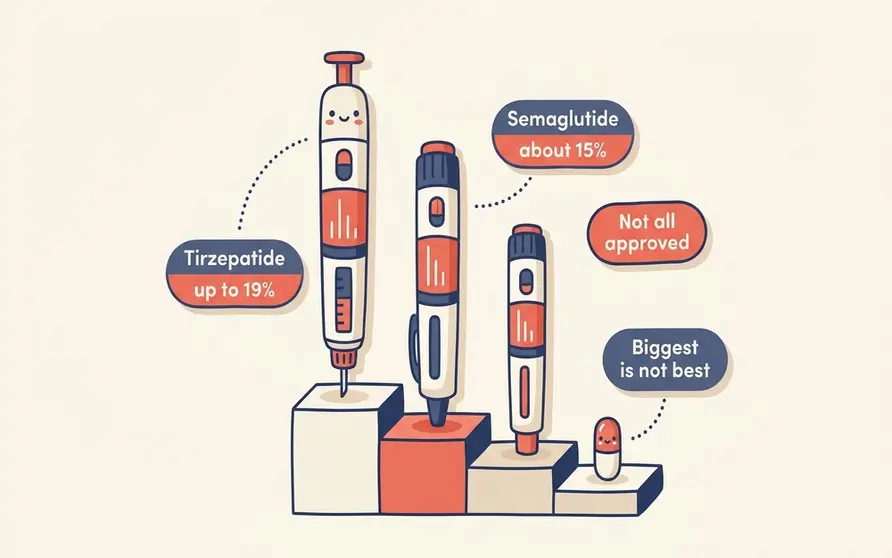
"Which GLP-1 drug makes you lose the most weight" is the single highest-volume question in this whole category, and for a long time the honest answer was a shrug, because the only comparisons were pairwise, drug against drug. In 2026 that changed. A new systematic review in Annals of Internal Medicine lined up the full current field, from the oldest injection to the newest pill and the next-generation multiagonists, in one ranked picture.
This article gives you that ranking, and then does the part the headline numbers leave out: why the biggest figure is not a winner, and why it may not even be the right drug for a given person. Nothing here is a reason to start, switch or chase a "stronger" drug on your own. That is a conversation for you and your doctor.
What did the 2026 review actually rank?
The review is an updated systematic review, published in Annals of Internal Medicine in October 2026, that gathered randomized controlled trials of GLP-1 drugs and co-agonists in adults who have overweight or obesity but not diabetes.1 It included 38 trials covering 25,816 people, adding 14 new trials and about 11,000 more participants to the authors' earlier review.1 It was led by an academic group at McGill University and the Lady Davis Institute in Montreal, and it reported no primary funding source, which is worth stating because it is not a manufacturer-run comparison.1
The measure it ranks is placebo-subtracted weight loss. That is the weight lost on top of what the placebo group lost, so it isolates the portion the drug itself is responsible for. Every figure below is an "up to" number, meaning the best result at the highest studied dose, so lower or starting doses lose less.
The 2026 ranking
Here is how the drugs ordered, most placebo-subtracted weight loss first. Note that two of the top three are emerging drugs that are not yet approved for weight management.1
| Drug | Status | Up-to loss vs placebo | 95% CI |
|---|---|---|---|
| Amycretin | Emerging | -23.9% | -29.3 to -18.5 |
| Retatrutide | Emerging | -22.1% | -24.9 to -19.3 |
| Tirzepatide (Mounjaro, Zepbound) | Approved | -19.0% | -21.6 to -16.4 |
| Subcutaneous semaglutide (Ozempic, Wegovy) | Approved | -14.8% | -16.2 to -13.4 |
| Oral semaglutide | Approved | -14.3% | -17.2 to -11.4 |
| Orforglipron (Foundayo) | Approved | -12.4% | -15.1 to -9.7 |
| Liraglutide | Approved | -5.8% | -8.0 to -3.6 |
Placebo-subtracted "up to" weight loss from the 2026 Annals of Internal Medicine systematic review, adults with overweight or obesity and without diabetes.1 Figures are best-case at the highest studied doses; type-2-diabetes populations typically see smaller numbers. Confidence intervals overlap between adjacent drugs.
Why is the biggest number not the winner?
Because the review could not turn this list into a true head-to-head league table. The authors state plainly that heterogeneity precluded quantitative synthesis, meaning the trials were too different in design, dose and population to be statistically pooled.1 So the ranking is descriptive, and the confidence intervals of neighbouring drugs overlap.
Amycretin is the clearest example. Its range runs from -29.3% all the way to -18.5%, and that lower end sits right alongside tirzepatide at -19.0%.1 That is why the review calls the top numbers "numerically greater," not "proven better." Reading amycretin as having beaten tirzepatide goes past what the evidence actually shows.
What does placebo-subtracted mean?
Placebo-subtracted weight loss is the weight lost on top of what the placebo group lost. People in the placebo arm still lose some weight through diet, activity and simply being in a trial, so a real person's total loss is usually larger than the placebo-subtracted figure.1
What the ranking isolates is the drug-attributable portion, which is the fair way to compare one drug with another. It is not the number you would expect to see on your bathroom scale, and it is not the "up to 15 percent" or "up to 20 percent" total-weight headline you may have read elsewhere. The two numbers answer different questions.
"Numerically greater is the review's own phrase. It is not the same as proven to beat."
Which drugs are not approved yet?
The review itself splits the field into commercially available therapies and emerging multiagonists, and the split matters when you read the ranking.1 The two drugs at the very top, amycretin and retatrutide, sit in the emerging group. They are still in trials and are not approved for weight management, so the biggest numbers on the list belong to drugs you cannot be prescribed for weight loss today.
The approved drugs are the rest: tirzepatide, subcutaneous and oral semaglutide, orforglipron, which is sold as Foundayo, and liraglutide. If you want the ranking among drugs that actually exist on the pharmacy shelf, tirzepatide is at the top. For the oral option specifically, the Academy covers how much weight you can lose on Foundayo in its own article.
How safe were the drugs across the trials?
A ranking by weight loss is only half the picture, so the review also pooled side effects. Gastrointestinal effects stayed common across the class, reported in 76.0% of people on a GLP-1 drug versus 40.1% on placebo.1 These are the familiar nausea, vomiting and diarrhea, usually worst while the dose is being raised.
Stopping treatment because of side effects was generally low, 10.7% versus 3.4% on placebo, though it was numerically higher with some of the oral agents. Serious adverse events (6.5% versus 5.2%) and deaths (0.1% versus 0.0%) were rare, and the review reported no new safety signals.1 For the full long-horizon safety question, see the Academy's piece on whether GLP-1 drugs are safe to take long term.
So which drug should I choose?
That is not a question a ranking can answer, and the review is careful not to pretend otherwise. The biggest placebo-subtracted number is not automatically the best drug for a given person. Approval status, how well you tolerate it, cost and insurance, and whether it is a once-weekly injection or a daily pill all weigh into the real decision.
If your actual question is the common tirzepatide-against-semaglutide choice, the Academy answers that specific pairwise comparison in its dedicated article on which of the two loses more weight. This ranking is the wider map; your prescriber helps you read it for your own situation, never a headline and never this article.
In one sentence: In the most current 2026 review, tirzepatide led the approved drugs for placebo-subtracted weight loss at up to 19.0% with emerging amycretin and retatrutide numerically higher, but the trials could not be pooled and the intervals overlap, so the ordering is a guide, not a verdict, and the biggest number is not automatically the right drug for you.
Frequently asked
Which GLP-1 drug causes the most weight loss?+
What does placebo-subtracted weight loss mean?+
Is the drug with the biggest number the best choice?+
References
- Moiz A, Filion KB, Samuels AE, Tsoukas MA, Yu OHY, Peters TM, Eisenberg MJ. Efficacy and Safety of Glucagon-like Peptide-1 Receptor Agonists and Co-agonists for Weight Loss Among Adults Without Diabetes: An Updated Systematic Review. Annals of Internal Medicine, 2026 Oct;179(10):1412-1429. doi:10.7326/ANNALS-25-05519; PMID 42673585. Updated systematic review of 38 randomized trials (25,816 adults with overweight or obesity and without diabetes), MEDLINE, Embase and Cochrane CENTRAL searched 5 October 2024 to 25 March 2026; heterogeneity precluded quantitative synthesis. Academic authors at McGill University and the Lady Davis Institute, Montreal; no primary funding source reported (PROSPERO CRD42024505558).
Evidence current as of October 30, 2026. This article is general information, not medical advice. GLP-1 drugs are prescription-only and should be used under medical supervision; always consult a qualified clinician before starting, stopping or changing a medication.
Translating new metabolic and obesity research into plain English for people living on GLP-1 therapy. Every claim is traced to its source.