Can Ozempic or Mounjaro help psoriasis?
There is early, encouraging evidence that GLP-1 drugs like Ozempic and Mounjaro can calm psoriasis, but no large trial has tested it. A 2026 review of 26 studies found semaglutide and liraglutide cut psoriasis severity scores sharply in small groups, mostly through weight loss. A few people had flare-ups instead.
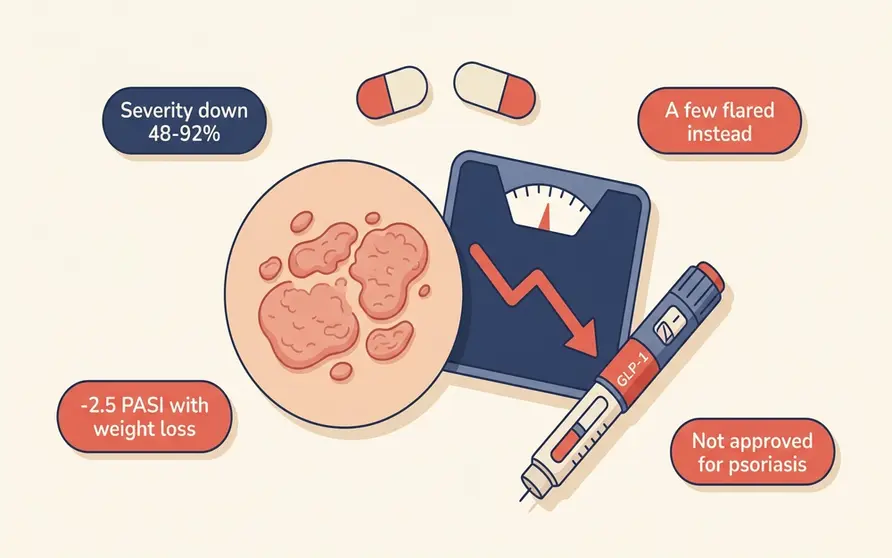
Psoriasis is a common, long-term condition where the immune system speeds up skin turnover, leaving raised, scaly plaques that can itch and crack. It affects at least 60 million people worldwide, and about 80% of them also live with overweight or obesity.2 That overlap is why a natural question has followed the rise of GLP-1 drugs: if Ozempic, Wegovy and Mounjaro drive large weight loss, can they also calm the skin?
The honest 2026 answer is cautiously encouraging. Small studies repeatedly show psoriasis improving on these drugs, and the strongest driver appears to be the weight loss itself. But no large trial has tested a GLP-1 drug as a psoriasis treatment, a few people flared instead of improving, and none of these medicines is approved for the skin. Nothing here is a reason to start, stop or switch a treatment on your own.
Can Ozempic help psoriasis?
The best current summary comes from a 2026 systematic review in the Journal of Clinical Medicine, which pooled 26 studies of GLP-1 drugs in people with psoriasis.1 Across case reports, case series, observational studies and a small number of trials, the pattern leaned clearly toward improvement, with severity scores falling substantially in most reports.1
Doctors measure psoriasis with the Psoriasis Area and Severity Index, or PASI, where a higher number means worse disease and a drop means clearer skin. In the review, liraglutide lowered the average PASI score from 15.7 to 2.2 over 12 weeks across 87 patients, and about 73% of treated patients reached PASI75, meaning a 75% improvement.1 Semaglutide, studied in 61 patients, produced reductions ranging from 48% to 92%.1
What did the 2026 review find?
The review looked at each drug separately rather than lumping them together, which matters because they were studied in very different numbers of people. The table below sets out what was reported for the three GLP-1 drugs with the most psoriasis data.
| Drug | Studies and patients | Psoriasis result reported |
|---|---|---|
| Liraglutide | 11 studies, 87 patients | Average PASI 15.7 to 2.2; about 73% reached PASI75 |
| Semaglutide | 5 studies, 61 patients | Severity scores fell 48% to 92% |
| Tirzepatide | Case reports plus a 274-person trial | Up to 95% clearance; 41% fully cleared when added to a biologic |
Tirzepatide, the newest of the three, has the least standalone data but the most interesting trial. In a phase 3b study of 274 people with psoriasis and excess weight, adding tirzepatide to the skin biologic ixekizumab pushed complete skin clearance (PASI100) to 40.6%, higher than the biologic alone.1 Around 27% of that combination group reached both complete clearance and at least 10% weight loss at the same time.1
Why would a weight-loss drug clear skin?
The leading explanation is the weight loss itself. Fat tissue is not inert; it releases inflammatory signals that can worsen psoriasis, and excess weight is linked to more severe disease and a poorer response to skin treatments.2 A 2026 meta-analysis of 13 randomized trials in 1,145 people put a number on it: weight-loss interventions, with an average loss of about 6.7 kg, lowered PASI scores more than usual care and improved quality of life, evidence the authors rated as high-certainty.2
There may also be a direct effect. GLP-1 receptors sit on immune cells, and the systematic review notes that some psoriasis improvement appeared even where weight loss was modest, hinting at a weight-independent anti-inflammatory action.1 This is the same immune-calming idea being explored for whether GLP-1 drugs help hidradenitis suppurativa, another inflammatory skin condition. How much comes from weight loss and how much from the drug directly is still unresolved, and the amount of weight these drugs cause is covered in our guide to tirzepatide versus semaglutide weight loss.
Can GLP-1 drugs make psoriasis worse?
Sometimes, and honestly reporting this matters. The same 2026 review that found widespread improvement also documented paradoxical psoriasiform eruptions and flares, where the skin got worse rather than better after a GLP-1 drug was started.1 These were uncommon: roughly five cases across all the drugs combined.
The reported flares spanned several agents. There was one case of new psoriasis-like rash four days after starting exenatide, two flares with tirzepatide, one severe worsening about two weeks after starting liraglutide, and one exacerbation noted in a semaglutide trial.1 Why the same drug class helps most people and worsens a few is not understood, but it is a real signal worth watching in the first weeks of treatment.
The pattern points one way, toward calmer skin, but a handful of people flared instead. That is the honest shape of early evidence.
Should you take Ozempic for psoriasis?
Not for psoriasis on its own. No GLP-1 drug is approved to treat psoriasis, and the current evidence is mostly small case reports and observational studies, not the large randomized trials that regulators and dermatologists rely on.1 The review's own authors say adequately powered trials are needed before GLP-1 drugs can be recommended for the skin.1
The practical picture is different if you have both psoriasis and excess weight. In that case, losing weight is already considered part of good psoriasis care, whatever method achieves it.2 So if a GLP-1 drug is prescribed for an approved reason such as type 2 diabetes or obesity, clearer skin may come as a genuine bonus. That decision belongs with your doctor and dermatologist, who can weigh your whole picture rather than treat the skin in isolation.
In one sentence: early evidence suggests GLP-1 drugs like Ozempic and Mounjaro can ease psoriasis, mostly by driving the weight loss that itself calms the disease, but a few people flare, no large trial has confirmed it, and no GLP-1 is approved to treat the skin.12
Frequently asked
Is Ozempic approved to treat psoriasis?+
Does losing weight improve psoriasis?+
Can Ozempic or Mounjaro cause a psoriasis flare?+
Which GLP-1 drug is best studied for psoriasis?+
References
- Marani A, Neri E, Morea E, Bertolla D, Gualdi G, Borghi A, Conti A, Amerio P. Effects of GLP-1 receptor agonists on psoriasis: an "agent-specific" systematic review of the literature. Journal of Clinical Medicine. 2026 Jul 1;15(13):5126. DOI: 10.3390/jcm15135126. PMID: 42452586. A PRISMA systematic review of 26 studies (case reports, case series, observational studies and randomized trials). Semaglutide (5 studies, 61 patients) produced PASI reductions of 48% to 92%; liraglutide (11 studies, 87 patients) lowered mean PASI from 15.7 to 2.2 over 12 weeks with PASI75 in about 73%; tirzepatide data included case reports and a 274-patient phase 3b trial (TOGETHER-PsO) combining it with ixekizumab, reaching PASI100 in 40.6%. Roughly five paradoxical psoriasiform flares were reported across the agents. The authors note the evidence is mostly small and observational and call for adequately powered randomized trials.
- Morrow S, Hawkins P, Griffiths CEM, Tektonidis TG, Harriss E, Scragg J, Jebb S. Impact of weight-loss interventions on psoriasis severity: a systematic review and meta-analysis. Journal of the European Academy of Dermatology and Venereology. 2026 Jun;40(6):980-993. DOI: 10.1111/jdv.70247. PMID: 41416383. A meta-analysis of 13 randomized controlled trials in 1,145 adults with psoriasis. Weight-loss interventions (mean weight change about -6.7 kg) produced a greater fall in PASI than control (mean difference -2.5, 95% CI -3.8 to -1.1) and higher odds of reaching PASI75 (relative risk 1.6, 95% CI 1.1 to 2.2), with improved quality of life; the authors rated this high-certainty evidence and report that about 80% of people with psoriasis also live with overweight or obesity. Disclosures: some authors report research grants (British Skin Foundation, NIHR) and PhD studentship funding.
Evidence current as of September 29, 2026. The GLP-1 psoriasis evidence rests largely on small case reports, case series and observational studies, with few randomized trials, so it shows association and early signal rather than proof, and the systematic review's authors call for adequately powered trials. Reported paradoxical flares were uncommon (about five cases across all agents) but real. No GLP-1 or GLP-1/GIP drug is approved to treat psoriasis. This content is educational only, not medical advice. Do not start, stop or change any medicine, including a psoriasis treatment, based on this article; discuss psoriasis care with your doctor and dermatologist.
Translating new metabolic and obesity research into plain English for people living on GLP-1 therapy. Every claim is traced to its source.