What is Wegovy HD, and is the higher dose worth it?
Wegovy HD is a higher-dose version of semaglutide - 7.2 mg once a week - approved by the FDA in March 2026 for adults already on the standard 2.4 mg dose who need more weight loss. In the STEP UP trial it took off about 3 percentage points more weight than 2.4 mg, but nearly four times as many people reported altered skin sensations.
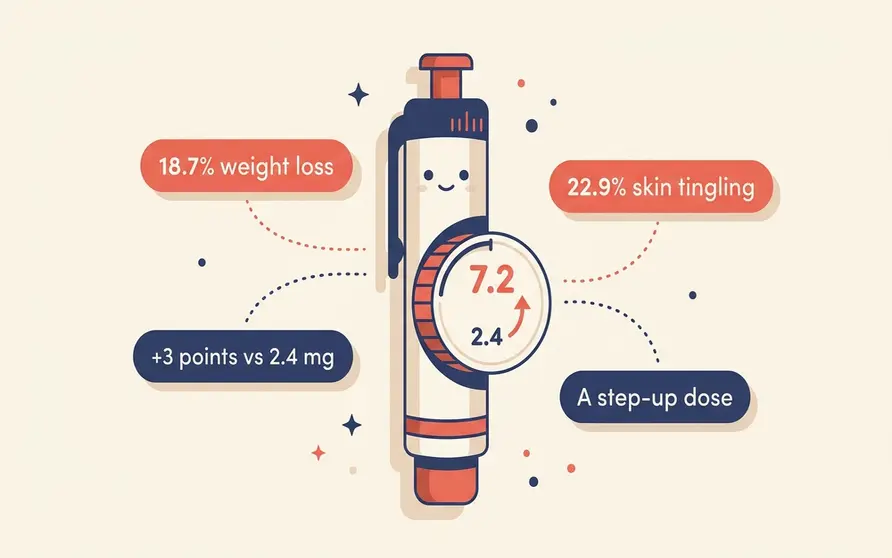
For most people on Wegovy, the top dose has been 2.4 mg a week. Some lose less than they hoped at that dose, and the obvious question is whether going higher would help. In 2026 that stopped being hypothetical: a stronger version arrived, and with it a fresh wave of searches asking what it is and whether the extra strength is worth it. This article answers both from the one large trial that tested it.
What is Wegovy HD?
Wegovy HD is a higher-dose version of semaglutide, the same active ingredient as standard Wegovy and Ozempic, dosed at 7.2 mg once a week instead of 2.4 mg. That makes it the highest injectable semaglutide dose available. The FDA approved it on March 19, 2026 for adults with obesity who have already tolerated the 2.4 mg dose for at least 4 weeks and for whom more weight reduction is clinically indicated, used alongside a reduced-calorie diet and more physical activity.2
The wording of that approval matters. Wegovy HD is a step-up option for people already on semaglutide, not a starting dose and not a first prescription. The question it answers is narrow: if 2.4 mg is not getting someone to their goal, does climbing to 7.2 mg add enough to be worth it?
How much more weight does 7.2 mg take off?
The evidence comes from STEP UP, a phase 3b randomised trial published in The Lancet Diabetes & Endocrinology. STEP UP enrolled 1,407 adults with obesity and without diabetes across 11 countries, and randomly assigned them to semaglutide 7.2 mg, semaglutide 2.4 mg, or placebo for 72 weeks.1 By the trial's published (treatment-policy) result, average body weight fell 18.7% on 7.2 mg, 15.6% on 2.4 mg, and 3.9% on placebo.1
So the honest headline is a gain of about 3 percentage points over the standard dose - the estimated difference between 7.2 mg and 2.4 mg was 3.1 points (95% confidence interval 1.6 to 4.7).1 The higher dose did push more people into the deepest weight-loss categories: compared with the 2.4 mg group, people on 7.2 mg were more likely to lose at least 20% of their body weight (odds ratio 1.8) and at least 25% (odds ratio 2.4).1
| Group (72 weeks) | Mean weight change | Altered skin sensations | GI side effects |
|---|---|---|---|
| Semaglutide 7.2 mg (Wegovy HD) | -18.7% | 22.9% | 70.8% |
| Semaglutide 2.4 mg (standard Wegovy) | -15.6% | 6.0% | 61.2% |
| Placebo | -3.9% | 0.5% | 42.8% |
Source: STEP UP, Wharton et al., The Lancet Diabetes & Endocrinology, 2025 (treatment-policy weight change; adverse-event rates among people who received at least one dose).1
Why do you see "about 21%" quoted?
Because the same trial can be summarised two ways, and the two numbers answer different questions. The 18.7% above is the treatment-policy result: it counts everyone assigned to 7.2 mg, including people who stopped the drug early. The figure of about 20.7% that appears in press coverage and marketing is the "as directed" (efficacy) result - what people lost if they stayed on the drug as prescribed.2 Neither number is fabricated; they measure different things.
The reason this matters is simple: the "as directed" figure is always the flattering one, because it sets aside the people for whom the drug did not work out. For deciding whether a dose is worth taking in real life - where some people do stop - the treatment-policy figure is the more honest anchor. That is why this article leads with 18.7% rather than the bigger number, and it is worth remembering whenever a weight-loss drug quotes a single headline percentage.
What are the side effects of high-dose Wegovy?
The extra weight loss does not come for free, and STEP UP measured the cost directly. Gastrointestinal side effects - nausea, vomiting, constipation and diarrhoea, the familiar complaints of this drug class - were reported by 70.8% of people on 7.2 mg, versus 61.2% on 2.4 mg and 42.8% on placebo.1 These effects are mostly dealt with the same way at any dose, which we cover in our guide to handling GLP-1 nausea without quitting.
The side effect that made headlines was different. Dysaesthesia - altered or abnormal skin sensations such as tingling, prickling or a crawling feeling - was reported by 22.9% of people on 7.2 mg, versus 6.0% on 2.4 mg and 0.5% on placebo.1 That is nearly a four-fold jump at the higher dose, and it is new enough that people are searching for it by name. It is worth separating this trial-reported symptom from the separate question of nerve damage driven by nutrient deficiency, which we cover in does Ozempic cause nerve pain or help it; STEP UP reported these skin sensations as an adverse event, not as a diagnosis of nerve injury.
One number cuts the other way, and it belongs in any honest summary. Serious adverse events were not more common at the top dose: they occurred in 6.8% of the 7.2 mg group, versus 10.9% on 2.4 mg and 5.5% on placebo.1 So the higher dose brought more of the common, tolerable side effects, without a rise in the rare, dangerous ones in this trial.
"The real question is not 7.2 mg versus nothing. It is 7.2 mg versus the 2.4 mg you are already on."
Is the higher dose worth it?
That is the decision the trial frames but cannot make for anyone. Set against each other, the two facts are these: moving from 2.4 mg to 7.2 mg added about 3 percentage points of weight loss, and it came with nearly four times the rate of altered skin sensations plus more gastrointestinal upset. For someone who is stalled well short of their goal on 2.4 mg and tolerating it well, that trade may be worth raising with a prescriber. For someone already losing steadily, the extra side effects may not be worth 3 points.
The comparison that matters is the right one to hold in mind. Headlines line Wegovy HD up against placebo (a 14.8-point gap), which makes it look dramatic.1 But nobody choosing Wegovy HD is choosing it instead of nothing - they are choosing it instead of the 2.4 mg dose they already take. Measured that way, the gain is real but modest. This is the opposite end of the dosing spectrum from the low-dose experiments some people try; we look at that end in does microdosing Ozempic or Mounjaro work.
Who is Wegovy HD for, and who is it not?
By its approval, Wegovy HD is for adults with obesity who have already tolerated 2.4 mg for at least 4 weeks and need more weight loss.2 It is not a starting dose, and the STEP UP trial that supports it enrolled adults with obesity and without diabetes, so its exact numbers describe that group rather than people taking semaglutide for type 2 diabetes.1
Two honesty notes close the picture. STEP UP was funded by Novo Nordisk, the maker of Wegovy, and several of its authors are Novo Nordisk employees, one of them named on a semaglutide patent.1 That does not invalidate a peer-reviewed phase 3b trial, but it is worth knowing. And none of this is a reason to escalate, start, stop or switch a dose on your own - that is a clinical decision, and anyone who develops new tingling, numbness or altered skin sensations should raise it with their prescriber.
In one sentence: Wegovy HD (semaglutide 7.2 mg) takes off about 3 percentage points more weight than the standard 2.4 mg dose, at the cost of nearly four times as many altered skin sensations and more gastrointestinal side effects, so whether it is worth it is a step-up decision to make with a clinician.
Frequently asked
What is Wegovy HD?+
What are the side effects of high-dose Wegovy?+
Is Wegovy HD better than the 2.4 mg dose?+
References
- Wharton S, Freitas P, Hjelmesaeth J, Kabisch M, Kandler K, Lingvay I, Quiroga M, Rosenstock J, Garvey WT; STEP UP trial group. Once-weekly semaglutide 7.2 mg in adults with obesity (STEP UP): a randomised, controlled, phase 3b trial. The Lancet Diabetes & Endocrinology. 2025 Nov;13(11):949-963. DOI: 10.1016/S2213-8587(25)00226-8. PMID: 40961952. Note: funded by Novo Nordisk; several authors are Novo Nordisk employees, one named on a semaglutide patent (US 12,029,779 B2).
- Henry C. FDA approves higher-dose semaglutide (Wegovy HD) injection 7.2 mg for obesity. Consultant360. March 19, 2026. Reports the FDA approval of Wegovy HD for adults who have tolerated the 2.4 mg dosage for at least 4 weeks and for whom additional weight reduction is clinically indicated, and the as-directed efficacy figure.
Evidence current as of October 21, 2026. This article is educational and not medical advice. Dose changes are a clinical decision; always consult your prescriber before starting, stopping or changing a medication.
Translating new metabolic and obesity research into plain English for people living on GLP-1 therapy. Every claim is traced to its source.